Why 9,6Hz Agency says no to fully AI-generated videos
By 9,6Hz Agency
Published
Updated
9,6Hz uses AI every day, but chooses real filming over fully generated videos. Our view on creative work, consent, source material and responsibility.
9,6Hz Agency does not use generative AI to make entire videos in place of real filming, and we do not copy other people’s ideas. Our team still uses AI every day. We want to be clear about which tasks a tool can help with, and which decisions filmmakers remain responsible for.
How is generative AI different from AI?
AI is a broad term for systems that perform tasks such as recognition, analysis and prediction. In video production, AI tools can help transcribe speech, find footage or process background noise. Each tool needs to be considered according to how it works and what material it uses.
Generative AI creates new content, including text, images, audio and video, from patterns learned during training. The term does not simply mean “fake video”, nor does it automatically mean copying. A writing assistant may also use generative AI.
Our “No to Gen AI” message refers to a specific filmmaking choice: we do not produce entirely generated videos to replace a shoot, a performance or a story that needs to be recorded with a camera.
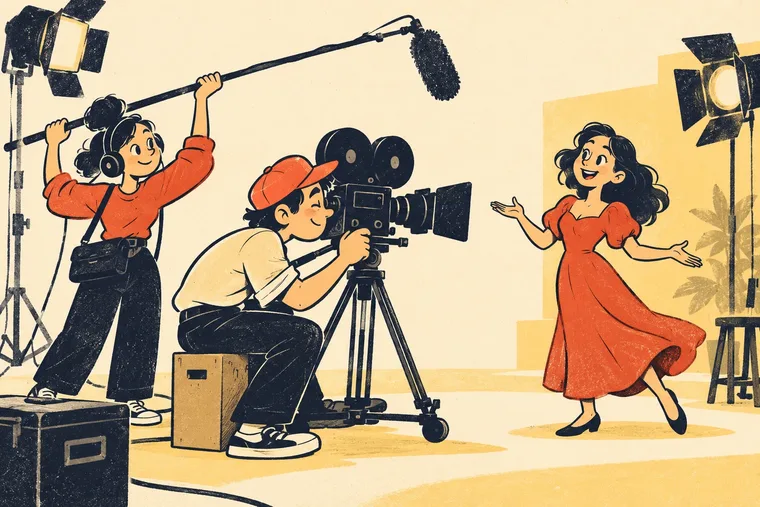
AI-generated conceptual illustration for this article. It does not show an actual 9,6Hz crew or project.
What is changing in filmmaking?
Text-to-video tools are now available in commercial platforms. Adobe’s Firefly documentation describes generating clips from text. Creating a scene without filming raises practical questions for clients: where did the imagery come from, who created it, and did the person represented agree to its use?
These questions matter to working filmmakers and performers too. SAG-AFTRA’s AI resources put consent and the protection of human performance at the centre of its AI and digital replica safeguards. A convincing image alone cannot answer those questions.
For 9,6Hz, permission to use material, the consent of participants and honesty with an audience all require an answer. Being able to write a prompt does not give someone permission to use another person’s face, voice or work.
What does 9,6Hz choose?
We choose to film real people, work with real settings and edit material we have permission to use. A pause in an interview, a chef’s gesture or a change in light across a product are things we want to observe and record.
AI can assist with work. Story decisions, camera choices, editing rhythm and responsibility for the finished film remain with our team. We do not use technology to disguise taking someone else’s ideas, or present a generated scene as evidence of something that happened.
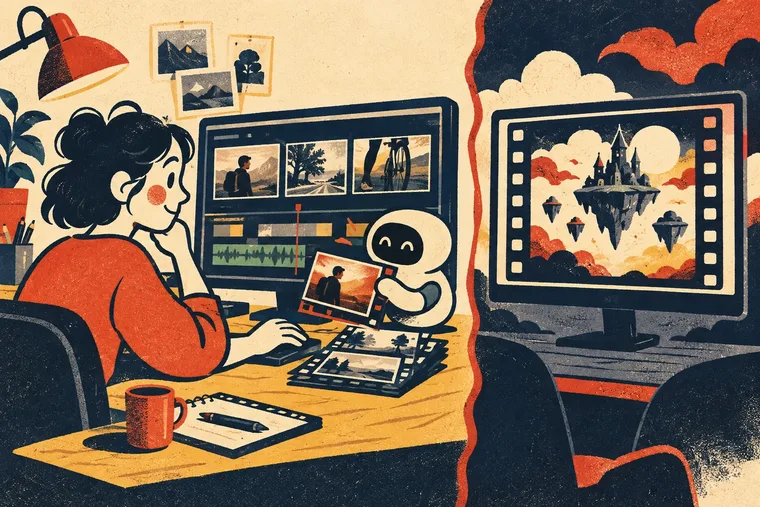
AI-generated conceptual illustration, disclosed as such. It is not footage or documentary production evidence.
Why does this article include AI-generated images?
These two illustrations were created to explain the position, and are labelled as AI illustrations. They do not depict a filmed project. Our boundary is not replacing real production with fully generated videos, misrepresenting the origin of imagery or copying ideas.
For a story filmed around real people and their work, explore our projects or send our team a brief. We can discuss what needs to be filmed and how to do it.