Beautiful AI Images Need More to Become a Real Film
By 9,6Hz Agency
Published
A film needs action, performance, coherent light, sound and editing rhythm. Learn how to review those relationships beyond a collection of beautiful AI images.
A beautiful image can establish atmosphere. A film also needs relationships across time: an action that begins and resolves, a performance that communicates intention, images that connect and sound that belongs to the scene. A collection of attractive AI pictures does not by itself answer those questions.
9,6Hz Agency uses AI to support daily work and can publish clearly disclosed AI concept illustrations. Its video approach keeps real filming central rather than replacing an entire film with generated scenes. This article examines the craft behind that choice without claiming that real filming automatically produces a good film or that generated imagery has no useful role.
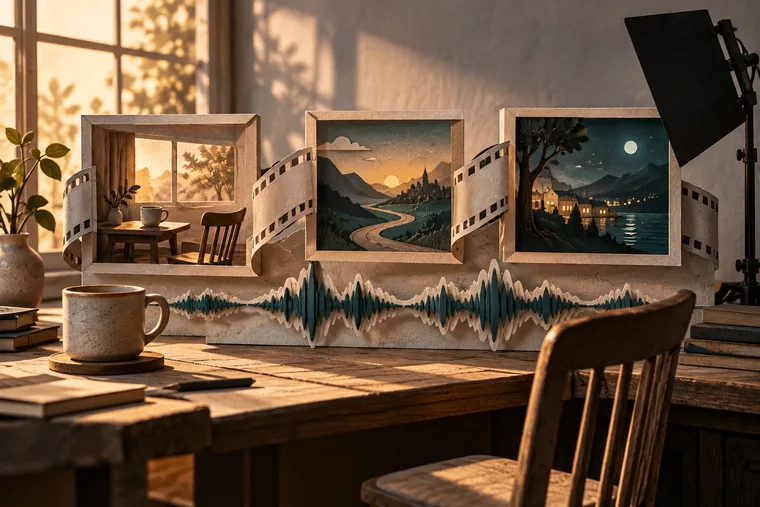
AI-generated editorial illustration of images, light and sound. These imagined scenes are not footage, a real set or a client film.
What changes between a still and a scene?
A still lets you choose one moment. A scene asks what happens before and after it. In a fictional cup film, a picture of a hand near a handle might look elegant. The filmed action must show the hand approaching, finding the handle, carrying weight and leaving the frame in a way the viewer understands.
Ask what the action changes. Does the person return to a task, wait for someone or make space at a table? Without a change, the scene may be only an attractive product display. That can be an appropriate format, but do not describe it as a character story if the film does not provide one.
Use concept images to discuss framing and atmosphere, then test the action. The best-looking still may not be the best camera position for a moving hand. You need to see the sequence rather than choose every shot from a thumbnail.
What does performance add?
Performance makes an action belong to someone. The same reach can feel distracted, careful, tired or eager depending on timing, gaze and physical behavior. A director's task is to choose what the scene needs and help the performer make it readable without forcing every gesture.
In the fictional scene, telling someone “feel warm” may be less useful than giving a playable action: finish reading the note, move the cup so the other person has room, then look toward the doorway. These are proposed instructions for an example, not a story about an agency shoot.
Watch complete takes. A moment that looks awkward in a still may be natural within a movement, while a beautiful pose may feel stiff when held. Keep the performer's consent and the purpose of the scene clear. Real people are not interchangeable visual ingredients.
Why does light need continuity?
Light establishes how the audience reads space and material. The ARRI Lighting Handbook, fourth edition (2016), explains practical distinctions in light quality and control. It is an established craft reference checked for this article, not a new AI announcement.
For a sequence, ask whether direction, contrast and reflections connect across camera positions. A soft highlight on the cup in one shot and an unrelated hard shadow in the next can make the scene feel fragmented. Sometimes a change is intentional; if so, give it a story reason.
A generated concept may combine attractive light effects that cannot be reproduced together as shown. A camera test lets you decide what the real setup should achieve. You do not have to imitate the concept literally. Preserve the intended feeling through controllable choices and update the planning images accordingly.
What does the location contribute?
A location is more than a background. It affects movement, sound, access, camera positions and what can appear in the frame. A beautiful imagined room may not offer space for the action or a practical place to hide lighting equipment.
Recce with the scene in mind. Walk the action, listen to the room and inspect the viewing directions. For the fictional table scene, check whether the doorway can be seen without revealing distracting objects and whether nearby noise will interfere with a quiet pause.
Use the location's actual qualities rather than treating it as a failure to match an image. A smaller room may give the scene intimacy; a different window can motivate another composition. Discuss the adjustment before the shoot so the client understands what is changing and why.
How do shots become a relationship?
A shot list should provide the editor with connected actions, not just several attractive angles. Establish where the person and object are, then choose details that advance the scene. Keep relevant screen direction, gaze and object position understandable when the camera changes.
In the cup example, record enough of the reach in one coherent take before collecting details. A close-up of fingers and a separate hero cup shot may not cover the moment when the cup leaves the table. That missing connection can force an edit that the audience notices even if every frame is beautiful.
The Academy's film-editing education guide discusses how shot selection and combination shape action and rhythm. Apply that as a question to your own material: what does this cut cause the viewer to notice or believe?
What does sound need to do?
Sound can connect spaces and actions that the image alone does not explain. A cup touching wood, a chair moving or a breath before speaking can make a scene feel specific. Record the material you need and give it room in the edit.
Choose music for the scene's actual rhythm and permitted use. Do not assume a track solves an unclear action. Watch once with the music muted and listen once without looking at the image. Those checks can reveal whether the scene relies on music to hide gaps or whether the sound is adding an unintended meaning.
Keep dialogue intelligible and reactions natural. Excessive cleanup can remove the texture of a voice or make room tone jump between edits. Review the exact export with sound rather than judging only a waveform, transcript or list of processing settings.
Where can AI usefully support this work?
StagePossible supportDecision that remains with peopleDevelopmentOrganize questions and compare ideasChoose the premise and its purposePre-productionCreate disclosed concept illustrationsTest action, light and practical scopePost-productionTranscribe, search or assist maskingSelect performance and maintain meaningReviewSuggest points to inspectConfirm issues in picture and soundKeep synthesis as a separate decision. Adobe's 2 April 2025 feature announcement includes Generative Extend, which adds generated content. That differs from finding an existing shot. Mentioning a capability does not mean 9,6Hz uses it or has approved it for a particular project.
If a concept picture helps the team agree on a visual question, use it with a clear label. If a transcript helps the editor locate a recorded passage, review it against the audio. The tool's role should stay connected to a specific task rather than becoming a reason to stop observing the real material.
How do you review rhythm without a formula?
Ask when the viewer has understood the action and what they need next. A fast cut can help energy or interrupt a reaction too early. A held shot can let a detail register or become empty. There is no universal duration that makes every moment cinematic.
Watch the film at normal speed from beginning to end. Check whether each change in pace has a reason. If a person pauses before responding, decide whether that pause tells the story rather than automatically removing it. If a product action is complex, give it enough time to read.
Do not judge motion from stills alone. A contact sheet can show composition and sequence order, but not performance, cadence or audio transitions. It is a useful review aid, not evidence that the full export works.
What belongs in the final quality review?
- Check that the film communicates its intended action and change.
- Watch the full exact export with sound.
- Review performance, continuity, light and product appearance.
- Confirm the relationship between images, speech and claims.
- Inspect subtitles, titles and the ending at the delivery size.
- Check disclosure and permissions for any generated or sourced material.
Review the picture after compression as well as before it when the delivery path changes what viewers receive. A subtle mask problem or unreadable title can appear at the final viewing size. Keep the source version so changes remain possible.
Separate technical success from editorial success. A file can export correctly and still end abruptly, obscure a product action or misrepresent a speaker. Delivery is complete when the actual result has been reviewed for the intended use, not just when the render finishes.
How should you explain the approach to a client?
Explain what real production contributes to their brief: a specific person, product, place, action or performance that viewers need to see. Describe how you will plan, film and edit those elements. Avoid treating “real” as a vague badge of quality.
Be equally clear about support tools. A disclosed AI illustration in a planning deck is not a claim that the scene already exists. A transcription aid is not a replacement for editorial listening. Confirm any meaningful change of approach before it becomes a delivery expectation.
Keep the story and practical scope connected. If the premise depends on a reaction, plan for that performance and coverage. If the product's real texture matters, test light and focus. These choices make the production approach understandable without promising an identical copy of an imagined frame.
Common questions
Can AI images be useful in filmmaking?
Yes, particularly as disclosed concepts. Their usefulness depends on the planning question, quality and appropriate use.
Does real footage guarantee a good film?
No. It still needs thoughtful direction, production and editing. This article argues for craft and responsibility, not an automatic guarantee.
Can beautiful frames replace a story?
They may suit a visual showcase. When a film promises a story, the actions and their relationships must deliver it.
Sources checked on 10 October 2026. Read the original-idea workflow, explore the portfolio, or discuss a real-filming approach with 9,6Hz Agency.