Original Creative Ideas: Use AI and References With Care
By 9,6Hz Agency
Published
Build original creative ideas from a brief and observation. Use AI to question and compare, then check your treatment against the references that shaped it.
An original creative idea needs a reason to exist in the specific brief. A new prompt or a different color palette does not automatically give a film a new premise. References and AI can help you explore choices, but the creative team still has to decide what the film observes, why it matters and how the idea changes through action.
9,6Hz Agency uses AI to support work, keeps real filming central and does not set out to copy other people's ideas. This article proposes a practical development method rather than claiming that any checklist can guarantee originality or settle a rights dispute. Its example is a fictional film for a ceramic cup.
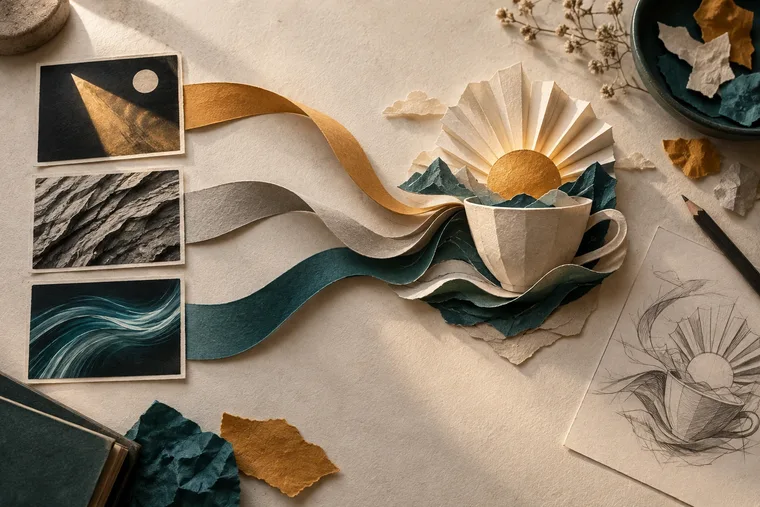
AI-generated editorial concept about developing an idea from different influences. It does not document a real treatment or client campaign.
Where should an idea begin?
Begin with the brief's actual problem. Suppose the fictional brand wants viewers to notice the cup's comfortable handle. A generic montage of beautiful pottery might be attractive while leaving that point invisible. The useful starting question is what action would let a viewer understand the handle without an unsupported voiceover claim.
Observe the real object. How does someone pick it up, set it down and turn it? What do you hear when it touches the table? Where does the hand naturally pause? Record observations separately from interpretation. “The thumb rests against this curve” is an observation you can test. “Everyone will feel relaxed” is an interpretation that needs more support.
If the product is not available yet, state that limitation. Develop provisional actions and plan a test. Do not let a model invent tactile qualities or product performance and then treat them as brand facts. The idea should grow from what you can responsibly show.
What does a useful reference teach you?
Name the quality, not just the source. A film might teach you how a held wide shot builds anticipation; a photograph might suggest a relationship between texture and side light; a sound recording might show how a small action can anchor a scene. Write a sentence explaining which quality you want to study.
Then identify what you are not borrowing: the distinctive premise, sequence of reveals, character relationship, dialogue or signature composition. “We like its rhythm” can conceal a nearly identical shot order. Be specific enough that someone outside the development conversation can see the difference.
Keep the reference's creator and source link with the note. Public availability does not establish permission to upload it to an AI service or reproduce it in a campaign. If you cannot confirm the intended use, work from a written description of the useful quality or obtain appropriate permission.
How can AI help without writing the whole film?
Ask it to challenge your draft. For the cup example: “What must a viewer see to understand the handle? Which parts of this idea depend on claims we have not tested?” These questions can reveal gaps without assigning authorship of the film's entire direction to a model.
Ask for alternatives with different underlying actions rather than cosmetic variants. One direction could follow a person reaching for the cup while distracted; another could center on setting it beside a letter. These are fictional possibilities, not approved concepts or accounts of agency work. Evaluate each against the brief before creating images.
Use AI to organize your own observations, identify unanswered questions or compare production implications. Review its suggestions for generic assumptions. A model may recommend a sunrise because it associates cups with morning, even when the real campaign concerns a late-night work habit. Familiar associations are starting material, not evidence about your audience.
What makes a treatment specific?
A treatment explains the film's premise and how image, action, sound and editing will realize it. Write the premise in a sentence that does not rely on adjectives. Then describe the opening action, the change in the scene and what the audience understands at the end. Add the role of the product, not just the time it appears.
For the fictional cup, a treatment could begin with an unfinished task on a desk, show a hand finding the handle without looking and end with the person returning to that task. That is a proposed observation about an action; the actual product and performance need testing. Explain camera distance, hand position and sound as choices serving that premise.
Distinguish intention from execution requirements. A quiet scene may need controlled background noise, patient performance and a camera position that keeps the handle readable. If the location cannot provide those conditions, adapt the plan. “Quiet” becomes useful when you can say what the viewer will see and hear.
How do you check similarity beyond colors?
ElementQuestionIf the resemblance is too closePremiseIs the same unusual situation doing the same job?Return to the brief and find another observationProgressionDo the reveals occur in the same order?Rebuild the scene's cause and effectCharactersAre the relationships and reactions equivalent?Develop a different point of viewImagesAre distinctive compositions being repeated?Test a composition motivated by your actionSoundDoes the same cue create the same payoff?Find sound belonging to your own sceneCompare the treatment and rough storyboard with the reference notes. A new product, different room and changed palette may still leave the same memorable idea underneath. Conversely, sharing a common technique such as side light does not by itself establish copying. Review the combination and its role in the film rather than treating every resemblance as equivalent.
Invite someone who did not write the draft to identify the closest reference. Ask which moment feels borrowed and why. This is an editorial check, not a legal verdict. If a distinctive resemblance remains unresolved, stop polishing that route and develop a different one.
What should you do when an AI output looks familiar?
Do not assume either innocence or infringement from a first impression. Record the concern, locate the possible source where practical and compare the actual elements. If the image repeats a recognizable composition or character, remove it from the working deck while reviewing the route. Generating another color variant may leave the same problem intact.
Adobe's Generative AI User Guidelines require users to respect third-party rights. This is a service-specific rule, not a guarantee that an output has been cleared. Review the particular tool's terms, reference inputs, permissions and intended use; obtain specialized advice when a concrete rights question requires it.
Keep questions about training sources, output resemblance, permission and disclosure separate. They are related, but they are not interchangeable. You cannot infer that every generative model uses unauthorized material, nor can you infer that every output is safe because a provider describes licensed training sources.
Which records help the team make decisions?
Keep a compact development log: the brief version, observations, reference sources, selected prompts, reasons for choosing a route and unresolved similarities. Save actual revisions as they happen. A record of a decision is useful; a retroactively invented story about where the idea came from is not.
Record approvals at the right level. A client approving a moodboard may not have approved the dialogue, shoot scope or use of generated imagery in the finished film. Clarify those decisions before production. If the route changes because a reference is too close, explain the new premise and consequences.
These records are not a certificate of originality. They help your collaborators understand the development, avoid accidental reuse and revisit decisions. They also make it easier to credit contributions accurately instead of attributing every step to one person or to a tool.
How can the idea survive filming and editing?
Test the action on camera. If the cup handle is the point, an attractive wide shot that hides the hand may weaken the film. Keep the observable action legible while allowing the director and performer to discover natural timing. Protect the premise without treating a generated still as a frame-by-frame instruction.
In the edit, check whether the sequence still communicates the intended change. Music and fast cuts can make almost any material feel energetic, but they may obscure the reason the product is present. Watch once without the explanatory presentation. If the idea only makes sense when someone describes it, adjust the film.
Review final language as well. Do not add an unsupported product claim just because the pictures now look persuasive. The creative route should stay connected to what the object, performance and evidence actually support.
- Describe the premise without naming a reference.
- List the specific elements the reference contributed.
- Test whether your subject creates a different action and outcome.
- Revise the treatment before spending more effort on concept images.
Common questions
Is every use of references copying?
No. Studying techniques and describing influences can support development. The concern is how distinctive ideas and their execution are reused, alongside permissions for the material itself.
Does a unique prompt prove an original idea?
No. Prompts can differ while producing similar premises or images. Review the result and the film's structure.
Can a checklist guarantee rights clearance?
No. This is an editorial method. Concrete rights questions depend on the actual material, use and applicable circumstances.
Sources checked on 10 October 2026. Read the moodboard guide, explore the portfolio, or bring a brief to 9,6Hz Agency to develop a direction grounded in your own subject.